
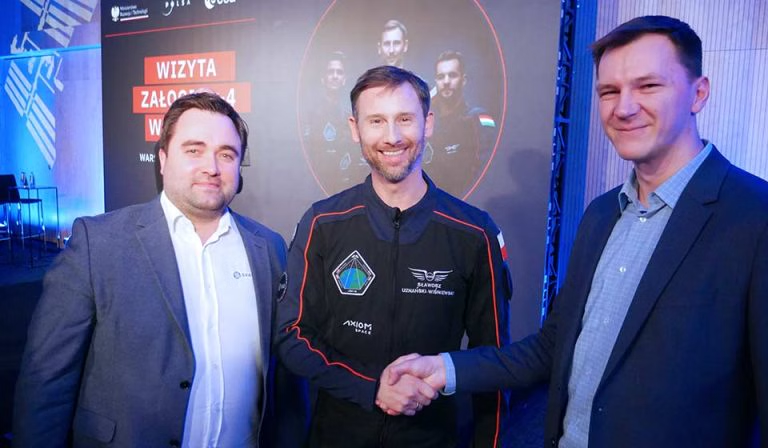
Interview with the CEO of SVANTEK
The conferences give the unique opportunity for valuable meetings. At OSA2025 in Szczyrk, it quickly became clear that we speak a similar language with the Svantek team. Although we operate in different areas of acoustics, we have surprisingly a great deal in common: family roots of companies, a consistent focus on high quality, and belief that good, long-term relationships are paramount in business.
There’s another common denominator – reliable in-situ testing. Both in the design of measuring devices and construction of noise barriers, there is one key question: does it really work? Without measurements taken before, during, and after implementation, it’s difficult to talk about knowledge – only assumptions remain.
We talk to Mr Bartłomiej Barwicz, the CEO of Svantek, about why precise measurements in the field are fundamental today, how a global technology brand is built and what connects acoustics with responsibility for space. We invite you to read on.
ABK: Congratulations on your participation in the latest space mission to the ISS (International Space Station). Participating in such groundbreaking events confirms your position among technology leaders. How did this happen that your devices flew into space?
Thank you very much. This was truly a very important event for us that confirms the quality of our technology, both for us and for the market. Our space journey began in 2016, somewhat without our involvement. NASA purchased our product from our distributor in the USA and began testing it and then using it on the ISS. Only later, as a result of this purchase, there was direct contact from NASA and regular collaboration was established. When, as part of preparations for the Polish IGNIS mission, the European Space Agency began recruiting for research and development projects, we decided it was a great opportunity not only to send more of our products into space, but also to be closely involved in the entire process of experiment preparation and product certification for space flight. So we applied and got the chance.
Svantek is now a global brand, but initially you had to convince the market to embrace Polish technology. How did you build a reputation as an acoustics leader among global manufacturers, and what was the breakthrough?
Establishing a presence on the global market was undoubtedly a huge challenge, especially for a technology company founded in the 1990s in Poland, which wasn’t necessarily associated with technological innovation. Achieving our current global position took us 35 years and consisted of many small steps and breakthroughs, rather than a single groundbreaking event. A crucial factor that undoubtedly contributed to our success was the fact that from the very beginning we aimed to have the best and most innovative products in the world, and we succeeded. And this philosophy is constantly nurtured and maintained. The second key factor was the systematic and persistent building of a global distribution network, which is now our great strength. Today our Polish products are virtually available in every developed and developing country in the world.
What mostly drew you in the world of acoustics? From the side, the devices you manufacture and sell look like highly precise technology. However everyone who talks to you feels the passion in your activity…
I’m glad that this passion can also be felt on the outside. My father conceived and founded Svantek, and from an early age, I’ve been involved in designing sound and vibration meters. I remember my father drawing with a pencil on a sheet several groundbreaking products while holding me on his lap. This certainly had a significant impact on me. However, I permanently became hooked and interested in acoustics after starting full-time work at the company. The multitude of interesting applications for our devices and the importance of sound and vibration measurements for our health and comfort, as well as for the operation and development of our infrastructure, turned out to be much greater than I ever imagined.
What technical solutions are currently most effective for measuring road and industrial noise?
In environmental measurements, the noise monitoring stations are by far the most rapidly developing products. We have quickly recognized this need and created a relatively small, integrated SV307 noise monitoring station with the SvanNET web platform for data collection, analysis, and reporting. It requires numerous advanced technical solutions to continuously measure with the highest precision, regardless of external weather conditions, and deliver results anywhere in the world.
There is no shortage of Asian measurement devices on the market—often at significantly lower prices. What are the differences between such equipment and Svantek solutions?
The biggest differences from such solutions are measurement precision, durability, and resistance to outdoor conditions. Our clients expect certainty that what they’ve measured is accurate and precise, and cheap meters from Asia do not provide them this . The importance of in-situ testing, i.e. actual field measurements, is increasingly being discussed. Why are they so crucial for data reliability?
Together with increasing prosperity and quality of life, we pay more attention to the noise and vibrations around us. Consequently, we expect increasingly precise data in this area. Acoustic models without field measurements cannot provide us with such accurate data. Therefore, supplement to models with real measurement data is becoming increasingly important.
Do you observe differences in the approach to noise in different countries?
Absolutely. We supply our instruments to over 70 countries worldwide, and the saying “so many countries so many customs” is extremely accurate here. Of course, most countries adhere to international standards for meters and measurement procedures, but there are still many differences. Noise measurements are closely linked to regulations, and these regulations are essentially different in each country.
You have conducted hundreds of measurements in various conditions. Is there a specific field situation that stands out in your mind? Did the noise come from an unusual source?
In Poland, we conduct measurements in our Accredited Environmental Laboratory, but we also hear many stories from our clients around the world. Acoustic measurements are a very interesting and often unpredictable field of research, so there have been many such cases. The first story that comes to mind is the measurement of a major industrial plant that was accused of exceeding noise limits, but after an initial inspection, the plant seemed to be relatively quiet. After installing the monitoring system, after the first few days, it turned out that exceedances were significant and far exceeded the expected results. After additional analysis of the recorded exceedances, it turned out that near the measuring point, unique loud and beautifully singing birds had their nest. Eliminating their singing from the measurement made the result more realistic and confirmed that there were no noise exceedances from the plant.
If you were to run a few years ahead, what do you think will change the most the way we measure and treat noise? AI, miniaturization, accessibility, or perhaps something completely different?
I think the development of AI, the technology it uses, and wireless communication will also significantly impact on the world of acoustic measurements. AI will make post-processing and analysis of measurement results much more efficient, and as a result, we will be able to analyze results from larger number of measurement points using the same amount of time as acoustic experts. An increasing amount of measurement data will be transmitted from meters directly to the cloud, where it will be stored and processed, making access to results much faster and more convenient. At the same time, more and more societies will attach more importance to the acoustic environment in which they live.
Thank you for the interview.
All graphics and photos are from www.svantek.com
